
📖 నిర్వచనం
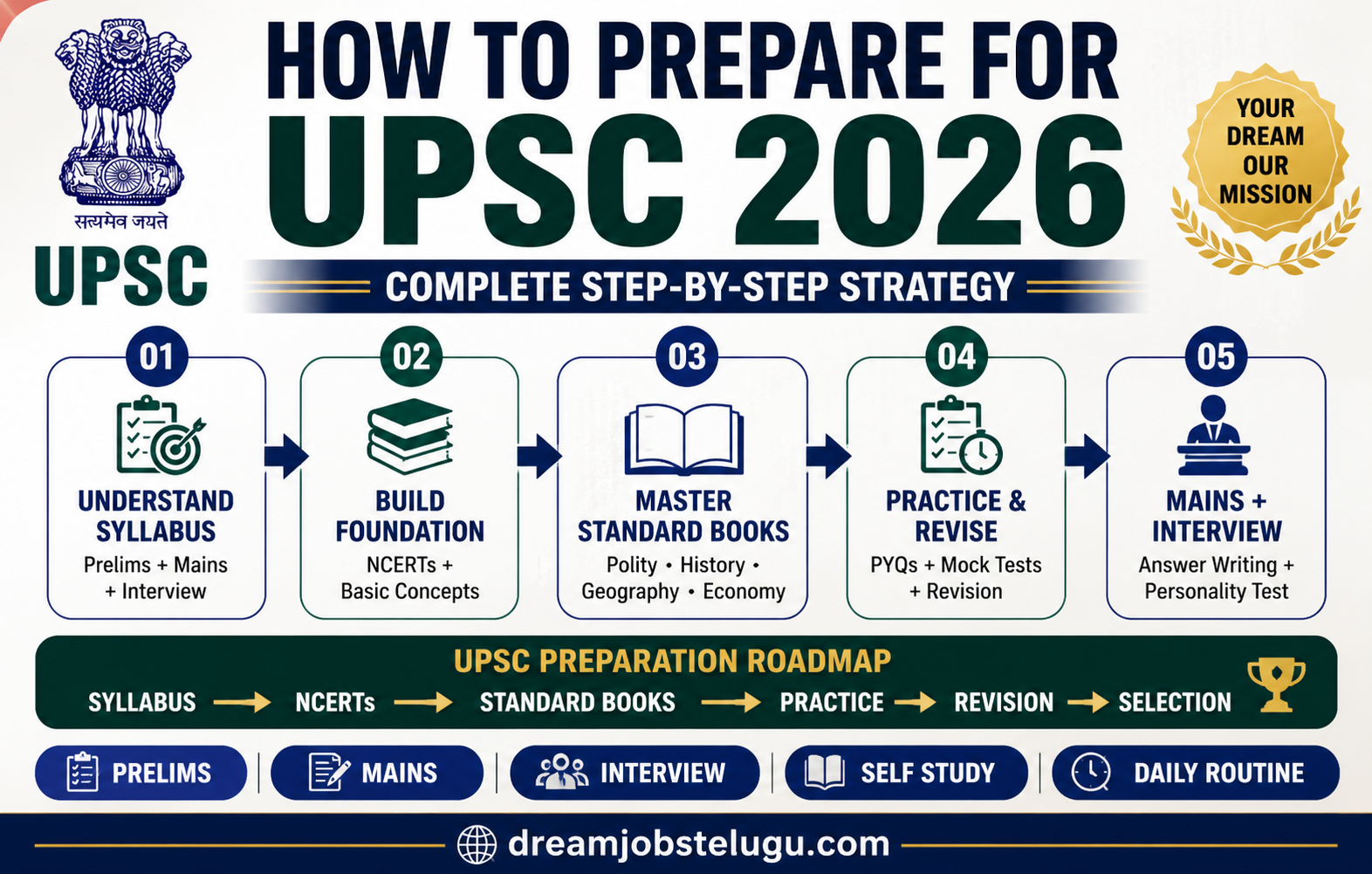
How to Prepare for UPSC అంటే — Civil Services Examination (CSE) కు systematically prepare చేయడానికి follow చేయాల్సిన strategy, study plan, timetable, మరియు approach. UPSC preparation typically 1–3 years లో complete అవుతుంది. Syllabus understanding → Right books selection → Daily study routine → Mock tests → Revision — ఈ 5-step cycle consistently follow చేయడమే UPSC preparation లో core strategy.
⚡ Quick Answer — How to Prepare for UPSC (5 Steps):
- Syllabus అర్థం చేసుకోండి — UPSC CSE 3 stages (Prelims + Mains + Interview) syllabus print తీసుకోండి
- NCERTs complete చేయండి — 6th–12th all subjects (Free, 3–4 months)
- Standard books read చేయండి — Laxmikant, Ramesh Singh, Spectrum, GC Leong
- Daily routine follow చేయండి — 8–10 hours study + The Hindu daily + notes
- Mock tests + Revision — Weekly mock test + 3× revision cycle
📊 Key Facts — UPSC Toppers మరియు Official Sources నుంచి
- As per upsc.gov.in Annual Report 2025–26 — UPSC CSE 2026 కు approximately 13 lakh candidates applied; Prelims appear చేసినవారు ~10 lakh; Mains shortlist ~14,000; Final selection ~1,000 candidates. Success rate: approximately 0.1% — అందుకే smart preparation mandatory.
- As per UPSC topper interviews (IAS SETU, Shubham Kumar AIR 1, Ishita Kishore AIR 1) — Successful candidates average study hours: 6–10 hours/day; average preparation period: 2–3 years; multiple attempts: majority cleared in 2nd or 3rd attempt. Consistency > intensity.
- As per upsc.gov.in previous year papers — UPSC Prelims GS Paper I cut-off General category typically 87–98 marks (out of 200); Mains topper scores typically 950–1,050/1,750 (merit papers); Interview toppers score 180–220/275.
- As per UPSC topper surveys (Forum IAS, Insights on India) — Among UPSC crackers: 40% used coaching, 60% were self-study or partial coaching; coaching NOT mandatory — right strategy + right books + consistency = sufficient.
- As per LBSNAA (lbsnaa.gov.in) — Average age of IAS officers at joining: 26–28 years; most aspirants start preparation after graduation (21–24 years); 6 attempts available for General category — multiple chances to succeed.
📋 విషయ సూచిక (Table of Contents)
- UPSC Prepare చేయడానికి ముందు — 5 Clarity Questions
- How to Start UPSC Preparation from Zero
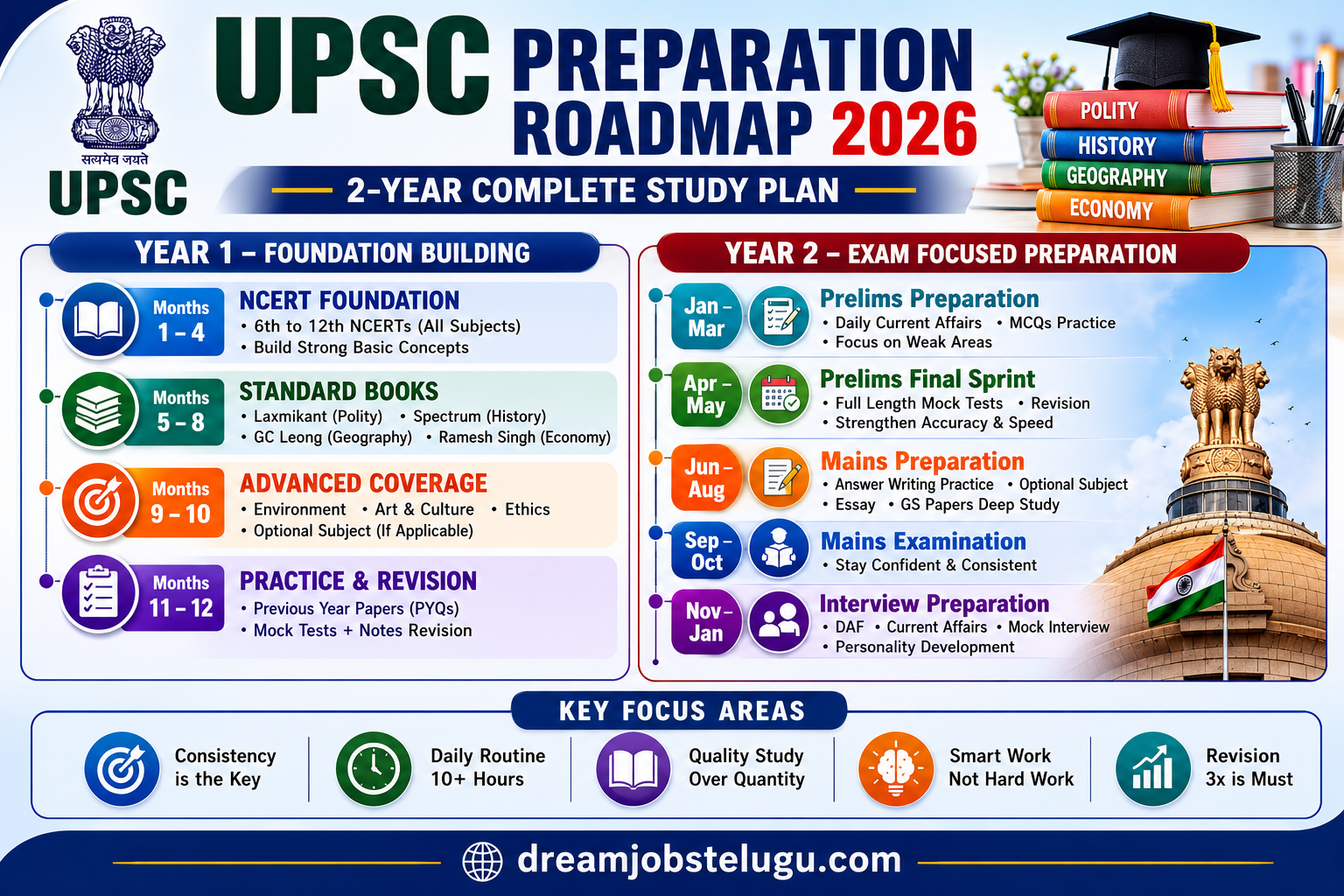
- UPSC Preparation Strategy — Year 1 Complete Plan
- UPSC Preparation Strategy — Year 2 Complete Plan
- UPSC Preparation Time Table — Daily Schedule
- Prelims Preparation Strategy — Stage Wise
- Mains Preparation Strategy — Paper Wise
- Interview Preparation Strategy
- How to Crack UPSC in First Attempt
- UPSC Preparation Without Coaching — Complete Strategy
- UPSC Preparation With Job — Working Professionals
- Revision Strategy — Smart Revision Plan
- Mock Tests & PYQ Strategy
- Current Affairs Daily Strategy
- Telugu Medium లో UPSC Preparation
- Motivation & Mental Health — Long Journey లో
- Common Mistakes — UPSC Aspirants చేసే తప్పులు
- Free Online Resources — Zero Cost Preparation
- Key Takeaways
- Frequently Asked Questions (FAQ)
How to Prepare for UPSC 2026 — Complete Step by Step Strategy Telugu లో
How to prepare for UPSC — ఈ question కు answer చాలా మంది complicated చేస్తారు. Coaching institutes, YouTube channels, books — అన్నీ different things say చేస్తాయి. కానీ UPSC toppers experience నుంచి చూస్తే — UPSC preparation formula simple: Right syllabus understanding + Right books + Consistent daily routine + Smart revision + Mock tests. ఇదే.
How to prepare for UPSC అని search చేస్తున్న మీరు ఈ journey start చేయాలనుకుంటున్నారు — అది right direction. 13 lakh candidates లో 1,000 మంది select అవుతారు — odds తక్కువగా ఉన్నాయి, కానీ right strategy తో achievable. ఈ guide లో how to prepare for UPSC — zero నుంచి start చేయడం నుంచి, coaching లేకుండా preparation వరకు, job తో పాటు prepare చేయడం వరకు — అన్నీ Telugu లో step by step ఉన్నాయి.
UPSC preparation ecosystem complete గా అర్థం చేసుకోవాలంటే: IAS Officer Complete Guide, UPSC Syllabus Guide, UPSC Exam Pattern Guide, మరియు UPSC Books List Guide కూడా చదవండి.
UPSC Prepare చేయడానికి ముందు — 5 Clarity Questions
How to prepare for UPSC start చేయడానికి ముందు ఈ 5 questions మీకు మీరు honestly అడుగుకోండి:
| Question | Why Important | Your Answer → Next Step |
|---|---|---|
| 1. నాకు IAS/IPS genuinely కావాలా? | 3-year difficult journey కు passion mandatory. Salary alone wrong motivation. | Yes → Continue. Unsure → Our IAS Guide read చేయండి |
| 2. నా age మరియు attempts eligible గా ఉందా? | General: 21–32 years, 6 attempts. OBC: 35 years, 9 attempts. SC/ST: 37 years, unlimited. | Eligible → Start immediately. Age crossing → Other govt jobs consider |
| 3. నా educational qualification ఉందా? | Any Bachelor’s Degree required. Final year students also eligible for Prelims. | Degree ఉంది → ✅. Degree incomplete → Final year లో Prelims give చేయవచ్చు |
| 4. నా financial situation support చేస్తుందా? | 2–3 years full-time preparation = no income. Family support or savings needed. | Support available → Full-time prep. No support → Job + UPSC parallel strategy |
| 5. Coaching కావాలా self-study చేయగలనా? | Coaching optional — not mandatory. Self-discipline, right resources తో self-study possible. | Strong self-discipline → Self-study. Guidance needed → Partial coaching consider |
How to Start UPSC Preparation from Zero — Step by Step
How to start UPSC preparation from zero — most aspirants ఈ stage లో overwhelm అవుతారు. Simple గా break down చేస్తే:
- UPSC official website visit చేయండి (upsc.gov.in) — CSE notification download చేయండి. Syllabus PDF print తీసుకోండి. Exam pattern clearly అర్థం చేసుకోండి. ఇది day 1 mandatory activity.
- NCERT Books download చేయండి (ncert.nic.in) — History, Geography, Political Science, Economics, Science — 6th నుంచి 12th వరకు అన్నీ free. Reading order: History → Geography → Polity → Economy → Science.
- Standard Books list prepare చేసుకోండి — Laxmikant (Polity), Spectrum (History), GC Leong (Geography), Ramesh Singh (Economy), Shankar IAS (Environment), Lexicon Ethics — ఇవి 6 mandatory books. Total cost ₹3,500 మాత్రమే.
- The Hindu subscription start చేయండి — Daily newspaper reading habit form చేసుకోండి. Day 1 నుంచే start — current affairs 18 months continuously accumulate అవుతాయి.
- Study space setup చేసుకోండి — Distraction-free study space, phone notification-off, study hours fixed — ఇవి physical setup. Environment preparation అన్ని మంది ignore చేస్తారు కానీ critical.
- Notes making system decide చేయండి — Hand-written notes vs Digital notes. Hand-written better for retention. Subject-wise separate notebooks maintain చేయండి.
- First week: UPSC previous year papers browse చేయండి — Last 5 years Prelims + Mains papers upsc.gov.in నుంచి download చేసి browse చేయండి. Question types, difficulty level అర్థం అవుతాయి.
UPSC Preparation Strategy — Year 1 Complete Plan
UPSC preparation Year 1 లో foundation building అత్యంత critical. ఇక్కడ shortcut వేయడం తర్వాత costly అవుతుంది:
| Month | Primary Focus | Books/Sources | Daily Hours | Milestone |
|---|---|---|---|---|
| Month 1–2 | NCERT Foundation Phase I | NCERT History VI–XII (all), Political Science IX–XII | 6–8 hrs | History complete, Polity basics clear |
| Month 3–4 | NCERT Foundation Phase II | NCERT Geography VI–XII, Economy IX–XII, Science VI–X | 6–8 hrs | All NCERTs complete + The Hindu habit formed |
| Month 5–6 | Standard Books Phase I | Laxmikant Indian Polity (full), Spectrum Modern India | 8–10 hrs | Polity mastered, Modern History strong |
| Month 7–8 | Standard Books Phase II | Ramesh Singh Economy, GC Leong Geography, Atlas practice | 8–10 hrs | Economy + Geography standard books complete |
| Month 9–10 | Remaining Books + Mock Tests | Shankar Environment, Nitin Singhania Art, Lexicon Ethics start | 8–10 hrs | All standard books complete |
| Month 11–12 | Prelims Mock Tests + Revision | Disha PYQ + online mock tests + Vision IAS monthly CA | 10–12 hrs | Prelims-ready. First full-length mock test attempt |
UPSC Preparation Strategy — Year 2 Complete Plan
Year 2 లో how to prepare for UPSC strategy shifts — Prelims attempt + Mains preparation simultaneous:
| Period | Focus | Activities | Goal |
|---|---|---|---|
| Jan–Mar (Pre-Prelims) | Intensive Prelims revision | Daily 100 MCQ practice, PYQ analysis, Current affairs consolidation, Weak areas target | Prelims cut-off clear (105+ General) |
| April–May (Prelims Month) | Final Prelims sprint | Full-length mock tests daily, The Hindu only current affairs, No new topics, Revision only | Prelims cleared → Mains shortlist |
| June–Aug (Post Prelims → Mains) | Intensive Mains preparation | Answer writing daily (2–3 answers), GS depth revision, Optional subject intensive, Essay practice | Mains preparation 80% complete |
| Sep–Oct (Mains Month) | Mains exam | Mock Mains tests, Answer writing speed practice, Current affairs final revision | Mains attempted with confidence |
| Nov–Jan (Post Mains → Interview) | Interview preparation | DAF fill carefully, Mock interviews (10+), Current affairs depth, Hobby/interest preparation | Interview cleared → Final selection |
UPSC Preparation Time Table — Daily Schedule
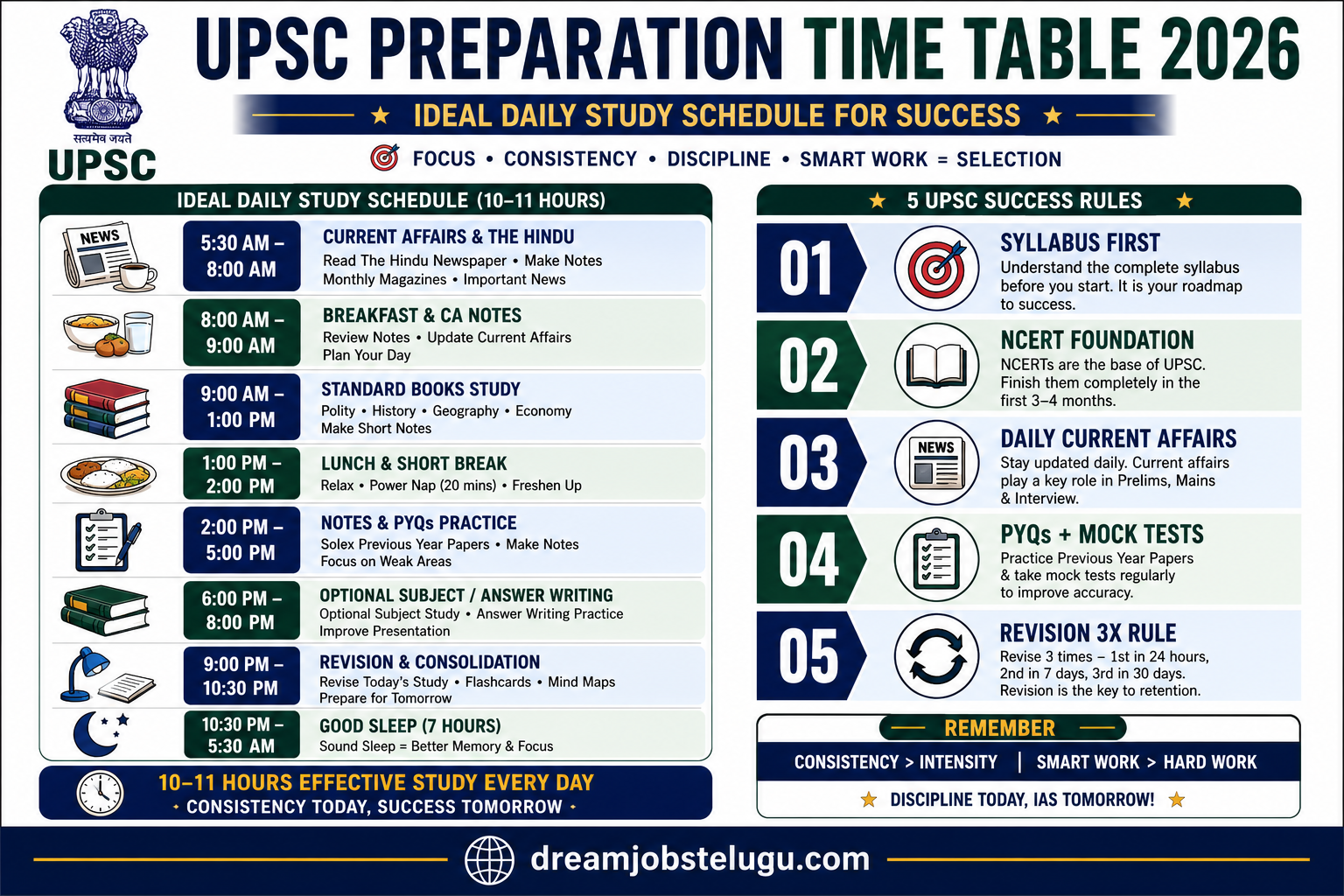
UPSC preparation time table — ఒక consistent daily schedule follow చేయడమే UPSC success కు single most important habit. ఇక్కడ proven daily schedule:
| Time | Activity | Duration | Why This Time? |
|---|---|---|---|
| 5:00–5:30 AM | Wake up, freshen up, light exercise/yoga | 30 min | Morning alertness maximum — brain fresh |
| 5:30–8:00 AM | The Hindu reading — National, International, Editorial, Science | 2.5 hrs | Fresh mind + newspaper = best retention |
| 8:00–9:00 AM | Breakfast + CA notes making from newspaper | 1 hr | Consolidate what was read |
| 9:00 AM–1:00 PM | Standard book study (primary subject of day) | 4 hrs | Peak concentration hours — most important slot |
| 1:00–2:00 PM | Lunch + rest | 1 hr | Physical recovery mandatory |
| 2:00–5:00 PM | Notes making + Previous year questions (PYQ) practice | 3 hrs | Application of morning’s reading |
| 5:00–6:00 PM | Break — walk, exercise, relaxation | 1 hr | Mental refresh mandatory — burns out without break |
| 6:00–8:00 PM | Optional subject study / Answer writing practice | 2 hrs | Evening — different subject keeps engagement |
| 8:00–9:00 PM | Dinner + relaxation | 1 hr | — |
| 9:00–10:30 PM | Revision of today’s notes + plan tomorrow | 1.5 hrs | Night revision = strong memory consolidation |
| 10:30 PM | Sleep — minimum 7 hours mandatory | 7 hrs | Memory consolidation happens during sleep |
| Total Study | — | 10–11 hrs effective study | Quality > quantity |
Prelims Preparation Strategy — How to Prepare for UPSC Prelims
UPSC preparation లో Prelims strategy — qualifying stage అయినా seriously prepare చేయాలి. Prelims fail అయితే Mains కు వెళ్ళే chance లేదు:
| Subject | Time Investment | Prelims Target | Key Strategy |
|---|---|---|---|
| Current Affairs | 25–30% of prep time | 20–25 questions correct | Daily Hindu + Monthly magazine + Notes. Last 12–18 months cover |
| Polity (Laxmikant) | 20% of prep time | 12–16 questions correct | Read 3–4 times. PYQ mapping. Constitutional provisions memorize |
| History | 15% of prep time | 12–16 questions correct | Old NCERTs + Spectrum. Modern History > Ancient for questions count |
| Geography | 12% of prep time | 10–14 questions correct | NCERTs + GC Leong + Daily map practice. Disaster management current |
| Economy | 12% of prep time | 8–12 questions correct | Ramesh Singh + Budget/Economic Survey + Current economy news |
| Environment | 8% of prep time | 8–10 questions correct | Shankar IAS one-time thorough read. National Parks + Acts memorize |
| Science | 5% of prep time | 5–8 questions correct | NCERT X Science + Current S&T news (ISRO, DRDO, Biotech) |
| CSAT (Paper II) | 3–5% of prep time | 66/200 qualifying | Numeracy + Reasoning focus. Past papers practice. 33% easy target |
Prelims Last 3 Months Sprint Strategy
- 3 months before Prelims: Start full-length mock tests (weekly). Identify weak areas. Targeted revision of weak subjects.
- 2 months before: Daily 100 MCQ practice. Current affairs consolidation (last 18 months). Laxmikant 4th reading.
- 1 month before: Only revision — no new topics. Daily mock test. Previous year papers (last 5 years). Sleep 8 hours mandatory.
- Exam day strategy: GS Paper I — attempt 80–85 confident questions. Skip uncertain. CSAT — Numeracy + Reasoning first, Comprehension last.
Mains Preparation Strategy — Answer Writing Focus
UPSC preparation లో Mains strategy fundamentally different from Prelims. Knowledge + Answer writing skill రెండూ necessary:
| Paper | Key Strategy | Answer Structure | Common Mistake |
|---|---|---|---|
| Essay (250 marks) | Weekly 1 essay write + evaluate. Diverse topic practice. Introduction + Body (4–5 paragraphs) + Conclusion structure. | 800–1000 words, multiple perspectives, examples, conclusion | One-sided view, factual only without analysis |
| GS I (History/Geography) | Current examples link చేయండి. Map-based questions sketch draw. Society questions NCRB data use. | 150–200 words, intro + 3–4 points + conclusion | Only historical facts, no contemporary relevance |
| GS II (Polity/IR) | Constitutional provisions quote చేయండి. Recent SC judgments add. India’s foreign policy current context. | 150–200 words, constitutional basis + analysis | Generic answers without specific provisions |
| GS III (Economy/Science) | Data + statistics use (Economic Survey). Government scheme link. S&T current developments. | 150–200 words, data-backed analysis | Vague economy answers without specific data |
| GS IV Ethics (250 marks) | Case studies: Stakeholders → Dilemma → Options → Best solution. Thinker quotes use. | Case study: 250–300 words; Theory: 100–150 words | No case study structure, vague moral statements |
| Optional (500 marks) | PYQ analysis first. Subject-specific answer format. Diagrams/flowcharts where applicable. | Subject-specific — typically 200–300 words per answer | Choosing wrong optional, inadequate preparation |
Interview Preparation Strategy — Personality Test
UPSC preparation లో Interview stage అనేది knowledge test కాదు — personality assessment. 275 marks final rank లో critical:
| Activity | When to Start | How |
|---|---|---|
| DAF (Detailed Application Form) Preparation | Before Mains form fill | Every word in DAF defend చేయగలగాలి. Hobbies, optional subject, home district, graduation subject — all thoroughly prepare. |
| Current Affairs — Last 6 Months | Post Mains immediately | Interview panel current issues extensively discuss చేస్తారు. National + International + State-level events. |
| Home State/District Knowledge | Throughout preparation | మీ hometown, district, state గురించి — history, economy, culture, issues — panel తప్పనిసరిగా అడుగుతారు. Local knowledge mandatory. |
| Mock Interviews | 2–3 months before interview | Minimum 10 mock interviews — different panels, different questions. Video record + self-evaluate. Coaching institutes, peer groups, online platforms. |
| Communication & Body Language | Throughout preparation | Confident posture, eye contact, clear speech. Telugu medium candidates telugu లో interview give చేయవచ్చు — interpreter available. |
| Newspaper Editorial Reading | Daily throughout | Multiple perspectives form చేసుకోవడం — interview లో balanced views show చేయాలి. One-sided opinions avoid. |
How to Crack UPSC in First Attempt — Proven Strategy
How to crack UPSC in first attempt — possible, కానీ requires exceptional preparation:
| Factor | What to Do | Common Trap |
|---|---|---|
| Early Start | Degree 2nd year నుంచే preparation start చేయండి — 3+ years preparation window | Degree complete అయిన తర్వాత start చేయడం — time pressured preparation |
| Prelims + Mains Parallel | Day 1 నుంచే Mains answer writing practice start చేయండి — Prelims clear అయిన తర్వాత 4 months window చాలా tight | Prelims clear అయిన తర్వాత Mains start చేయడం — insufficient time |
| Right Optional Early | 6 months లో optional decide చేసి preparation start చేయండి — 500 marks critical | Multiple optionals switch చేయడం, last minute change |
| Current Affairs Continuity | 18 months continuously current affairs maintain చేయండి — Prelims కు 12–15 months before start | Last few months Current Affairs cramming |
| Mock Test Culture | Month 6 నుంచే weekly Prelims mock + Daily Mains answer writing | Preparation complete అయిన తర్వాత mock tests start చేయడం |
| Revision Planning | Every book 3× revision mandatory. Notes from day 1 — revision easy అవుతుంది | Reading books once only — retention చాలా తక్కువ |
UPSC Preparation Without Coaching — Complete Self-Study Strategy
UPSC preparation without coaching — possible మరియు proven. 60% of successful candidates self-study లేదా partial coaching follow చేసారు:
| What Coaching Provides | Self-Study Alternative | Cost |
|---|---|---|
| Study Material | Standard books (Laxmikant, Ramesh Singh etc.) + free online notes (Insights, Vision IAS) | ₹4,000 (books) vs ₹1–2 lakh (coaching) |
| Current Affairs Guidance | The Hindu daily + Vision IAS Monthly magazine + PIB | ₹700/month vs included in coaching fees |
| Test Series | Insights on India Test Series (₹3,000–₹5,000) or ForumIAS (₹4,000) | ₹5,000 vs ₹30,000+ coaching test series |
| Answer Evaluation | Peer review groups (ForumIAS, Telegram UPSC groups) — free | Free vs ₹500–₹1,000 per answer |
| Doubt Clearing | YouTube (Unacademy free, StudyIQ, Dr. Sidharth Arora) + online forums | Free vs included in fees |
| Motivation | Study groups, UPSC aspirant communities, daily routine discipline | Free |
| Total Investment | ₹15,000–₹25,000 (books + test series + newspaper) | vs ₹1,50,000–₹3,00,000 coaching |
Without Coaching Success Keys:
- Self-discipline non-negotiable: No external deadline structure. Self-imposed weekly targets set చేసుకోండి — Sunday evaluation mandatory.
- Study group form చేసుకోండి: 3–5 serious aspirants group — daily discussion, doubt sharing, motivation maintain అవుతుంది.
- Online test series mandatory: Coaching నుంచి వచ్చే biggest value = test series. ₹5,000 investment లో quality test series available — skip చేయకండి.
- ForumIAS + InsightsonIndia daily: These two free platforms — daily current affairs, answer writing practice, peer evaluation — coaching equivalent value.
- YouTube wisely use చేయండి: Rajya Sabha TV (free), Unacademy free sessions, Vision IAS YouTube — quality content available. But don’t over-consume YouTube — reading > watching.
UPSC Preparation With Job — Working Professionals Strategy
How to prepare for UPSC with job — challenging కానీ achievable. Strategy:
| Time Available | Activity | Strategy |
|---|---|---|
| Morning (4:30–7 AM) | 2.5 hrs before office | The Hindu reading + quick CA notes. Most productive hours. Wake up early = crucial habit. |
| Commute Time | 30–90 min (one way) | Audio books (NCERT summaries), UPSC podcasts, Vision IAS audio current affairs. Passive learning. |
| Lunch Break | 30–45 min | Quick revision of morning notes / CSAT practice (mobile app). |
| Evening (7–11 PM) | 3–4 hrs after office | Standard book reading. Answer writing (1 answer/day). No social media. |
| Weekends | 8–10 hrs each day | Intensive study. Mock tests. Current affairs weekly consolidation. Group study. |
| Total per week | ~35–45 hrs | Less than full-time (70+ hrs) but sufficient with right strategy |
Revision Strategy — Smart Revision Plan
UPSC preparation లో revision అత్యంత neglected area — కానీ revision లేకుండా preparation incomplete:
| Revision Type | Frequency | How |
|---|---|---|
| Daily Revision | Every night (30 min) | Day’s notes quick scan. Key points recall. Next day preparation mental preview. |
| Weekly Revision | Every Sunday (2–3 hrs) | Full week’s notes consolidate. Weak areas identify. Next week planning. |
| Monthly Revision | End of month (full day) | Month’s current affairs consolidate. One subject complete book revision (notes only). |
| Pre-Prelims Revision | 3 months before exam | Full syllabus revision — notes only, not full books. Mock tests daily. Weak areas targeted. |
| Book Revision Cycle | Every 2–3 months | Laxmikant: 4–5 revisions total. Spectrum: 3–4 revisions. Each book minimum 3× revisions. |
Mock Tests & PYQ Strategy
How to prepare for UPSC లో mock tests మరియు PYQ (Previous Year Questions) practice two non-negotiable elements:
| Resource | When to Use | How to Use |
|---|---|---|
| UPSC PYQ (Last 10 Years Prelims) | From Month 3 onwards | Analyze question types, difficulty, frequency. Solve without looking at answers. Then analyze wrong answers deeply. |
| UPSC PYQ (Last 10 Years Mains) | From Month 6 onwards | Attempt writing full answers. Get evaluated. Note frequently asked topics. |
| Prelims Mock Tests | Monthly from Month 6; Weekly from Month 10 | Timed conditions — exactly 2 hrs. Analyze every wrong answer. Track score improvement. |
| Mains Mock Tests | From Month 8 onwards | Full paper mock (3 hrs). Speed + quality balance. Examiner perspective తో evaluate. |
| Current Affairs Tests | Weekly | Insights on India daily quiz (free). Monthly CA test from Vision IAS or Insights. |
Current Affairs Daily Strategy — How to Study for UPSC
How to study for UPSC current affairs — most candidates do it wrong. Effective strategy:
- Read The Hindu with syllabus in mind: ప్రతి news article ని UPSC syllabus topic కు link చేయండి. “ఈ article Polity కు relevant గా ఉందా? GS II IR కు relevant గా ఉందా?” అని think చేయండి.
- 3-Layer Current Affairs system: Layer 1 — The Hindu daily (main source). Layer 2 — PIB weekly (government initiatives). Layer 3 — Vision IAS Monthly (consolidation).
- CA Notes Making Format: Date → Topic → 3–5 bullet points → UPSC relevance (which paper, which topic). Short notes = fast revision possible.
- 1-Year Coverage mandatory: Prelims usually held in May — last year May నుంచి current May వరకు 12 months cover చేయండి. 18 months safer target.
- Selective Reading: Sports results, entertainment news, celebrity news — avoid. Focus: Government policy, Science, Economy, International relations, Environment, Defence.
Telugu Medium లో UPSC Preparation — Specific Strategy
How to prepare for UPSC in Telugu medium — challenging కానీ absolutely possible:
| Challenge | Solution |
|---|---|
| English Books Reading | Standard books (Laxmikant, Ramesh Singh) English లో read చేసి — Telugu లో notes make చేయండి. Bilingual approach most effective. |
| Current Affairs | The Hindu (English) mandatory. Telugu newspapers — supplement only. English newspapers alone UPSC current affairs cover అవుతాయి. |
| Mains Answer Writing | Telugu లో answers రాయవచ్చు — officially permitted. Formal, clear Telugu use చేయండి. Technical terms Telugu లో explain చేయండి. |
| Optional Subject | Telugu Literature optional — highly recommended. Native expertise + limited competition + good scoring. Previous year Telugu optional papers analyze చేయండి. |
| Interview | Telugu లో interview give చేయవచ్చు. UPSC panel accommodates. Confidence maintain చేయండి — language barrier excuse చేయకండి. |
| NCERT Telugu Medium | NCERTs Telugu medium లో available (ncert.nic.in). Foundation reading Telugu లో చేయండి — concept clear అవుతుంది. |
Motivation & Mental Health — Long Journey లో
UPSC preparation 2–3 year journey లో mental health maintain చేయడం equally important as subject preparation. Most candidates fail not due to lack of knowledge — but due to burnout and inconsistency:
| Challenge | Solution |
|---|---|
| Comparison with Peers | మీ journey మీది — others’ progress compare చేయడం stop చేయండి. ప్రతి aspirant different starting point నుంచి వస్తారు. |
| Social Media Overload | Instagram, Twitter UPSC “success stories” మరియు “toppers routines” constantly చూడటం anxiety increase చేస్తుంది. Limit to 30 min/day. |
| Family Pressure | Parents కు clear timeline explain చేయండి. Progress show చేస్తూ confidence maintain చేయండి. 1 year target set చేసుకోండి — review. |
| Failed Attempts | Fail అయిన attempt = learning opportunity. Analysis చేయండి: What went wrong? Which topics weak? Strategy adjust చేసి continue చేయండి. Average successful candidate 2–3 attempts తీసుకుంటారు. |
| Burnout Prevention | Weekly 1 day complete rest. Daily exercise (30 min). Hobbies maintain చేయండి. Study groups — isolation avoid. 12 hrs+ continuous study weeks కు harmful. |
| Motivation Maintenance | IAS officers inspiring stories read చేయండి. “Why IAS?” written note మీ study table మీద paste చేసుకోండి. Small milestones celebrate చేయండి. |
Common Mistakes — UPSC Aspirants చేసే తప్పులు
| # | Mistake | Why Wrong | Solution |
|---|---|---|---|
| 1 | NCERTs skip చేయడం | 30–40% Prelims questions NCERT level నుంచి వస్తాయి | NCERTs mandatory — skip చేయడం allowed కాదు |
| 2 | Too many books collect చేయడం | Surface reading many books = nothing retained | 1 book per subject, 3–5× revisions |
| 3 | Answer writing skip చేయడం | Mains లో knowledge alone insufficient — writing skill needed | Day 1 నుంచే daily 1–2 answers write చేయండి |
| 4 | Prelims లో only focus, Mains ignore | Prelims clear అయిన తర్వాత 4 months Mains window — very tight | Prelims + Mains simultaneously prepare చేయండి |
| 5 | Wrong optional choose చేయడం | 500 marks rank heavily influence చేస్తాయి | Interest + GS overlap + scoring + resources బట్టి choose |
| 6 | Mock tests avoid చేయడం | Real exam time pressure experience లేకపోతే exam hall లో panic | Month 6 నుంచే weekly mock mandatory |
| 7 | Notes making neglect చేయడం | Revision impossible without notes — time waste అవుతుంది | Day 1 నుంచే short, crisp notes habit |
| 8 | YouTube over-consumption | Watching videos reading replace చేయదు | YouTube maximum 1 hr/day — reading priority |
| 9 | Coaching blindly trust చేయడం | Coaching material alone insufficient — self-study critical | Coaching supplement, not substitute. Self-study primary. |
| 10 | Current affairs neglect చేయడం | 40%+ questions current affairs link అవుతాయి | The Hindu daily — no excuses, no holidays |
| 11 | Irregular study routine | Inconsistency = preparation incomplete, confidence low | Fixed daily schedule — 10 hrs minimum, 365 days |
| 12 | First attempt failure తో quit చేయడం | Average toppers 2–3 attempts take చేస్తారు | Failure = feedback. Analyze, improve, continue. |
Free Online Resources — Zero Cost UPSC Preparation
How to prepare for UPSC with zero or minimal cost — completely possible with these free resources:
| Resource | What’s Available | Link |
|---|---|---|
| UPSC Official | Syllabus, PYQ, notifications, admit cards, results | upsc.gov.in |
| NCERT | All textbooks 6th–12th free PDF download | ncert.nic.in |
| PIB (Press Information Bureau) | Government press releases, scheme updates, policy | pib.gov.in |
| PRS India | Bills, Acts, Parliament updates — excellent for Polity | prsindia.org |
| Insights on India | Daily current affairs, quiz, Mains answer writing evaluation | insightsonindia.com |
| ForumIAS | Discussion forums, free tests, answer evaluation community | forumias.com |
| Economic Survey | Annual Economic Survey free PDF | indiabudget.gov.in |
| Rajya Sabha TV / Sansad TV | “The Big Picture” debates, Panel discussions — free YouTube | YouTube: Sansad TV |
| Unacademy (Free) | Free UPSC lectures, strategy videos | YouTube: Unacademy |
| Vision IAS (YouTube) | Current affairs videos, strategy sessions | YouTube: Vision IAS |
🎯 Key Takeaways — How to Prepare for UPSC 2026
- How to prepare for UPSC — 5 core steps: (1) Syllabus + Exam pattern అర్థం చేసుకోండి, (2) NCERTs 6th–12th complete చేయండి (free, 3–4 months), (3) Standard books master చేయండి (Laxmikant, Spectrum, Ramesh Singh, GC Leong, Shankar Environment, Lexicon Ethics), (4) Daily 10+ hrs study + The Hindu routine maintain చేయండి, (5) Weekly mock tests + daily answer writing + 3× revision cycle follow చేయండి.
- UPSC preparation లో coaching mandatory కాదు — 60% successful candidates self-study లేదా partial coaching follow చేసారు; right books (₹4,000) + test series (₹5,000) + The Hindu (₹700/month) = total ₹15,000–₹20,000 investment తో coaching-equivalent preparation possible; discipline మరియు consistency ₹2 lakh coaching కంటే valuable.
- UPSC preparation time table లో Morning 5:30–8 AM The Hindu reading, 9 AM–1 PM standard book study, 2–5 PM notes + PYQ practice, 6–8 PM optional/answer writing, 9–10:30 PM revision — total 10–11 hrs effective study daily; Weekly 1 day rest mandatory; gradual build-up month 1 నుంచి.
- How to prepare for UPSC in first attempt: Degree 2nd year నుంచే start, Prelims + Mains simultaneously prepare, optional subject 6 months లో decide, current affairs 18 months continuous, daily answer writing from day 1 — ఈ 5 factors first attempt success rate dramatically increase చేస్తాయి.
- UPSC failure = feedback, not failure. Average successful candidate 2–3 attempts తీసుకుంటారు; General category 6 attempts available; ప్రతి attempt లో strategy analyze చేసి improve చేయండి — consistency + right strategy = eventual success.
Conclusion — మీ UPSC Journey Start చేయండి — Today!
How to prepare for UPSC — answer simple: Start today, start right, stay consistent. 13 lakh candidates లో మీరు different అవ్వడానికి intelligence కాదు — discipline మరియు smart strategy అవసరం.
UPSC preparation journey long — 2–3 years. కానీ ఆ 2–3 years తర్వాత వచ్చే life — District Collector గా thousands of lives change చేయడం, national policy లో contribute చేయడం — ఆ experience ఈ preparation journey worth చేస్తుంది.
ఈ guide లో ఉన్న strategy follow చేయండి. UPSC IAS complete ecosystem కోసం — IAS Officer Guide, UPSC Syllabus, Exam Pattern, Books List, మరియు IAS Salary Guide అన్నీ చదవండి.
Frequently Asked Questions (తరచుగా అడిగే ప్రశ్నలు)
Can I crack UPSC without coaching?
అవును — can i crack upsc without coaching absolutely yes. UPSC statistics ప్రకారం 60% successful candidates self-study లేదా partial coaching follow చేసారు. Coaching mandatory కాదు. Right books (₹4,000 investment): Laxmikant, Spectrum, Ramesh Singh, GC Leong, Shankar Environment, Lexicon Ethics. Free resources: NCERTs (ncert.nic.in), InsightsonIndia.com, ForumIAS, PIB, PRS India. Paid test series (₹5,000): sufficient. Total investment ₹15,000–₹20,000 తో coaching-equivalent preparation possible. Key: Self-discipline + Consistency + Right strategy.
How to start UPSC preparation from zero level?
How to start upsc preparation from zero: Step 1 — upsc.gov.in నుంచి CSE notification + syllabus download. Step 2 — ncert.nic.in నుంచి NCERTs 6th–12th free download (History, Geography, Polity, Economy, Science). Step 3 — Standard books purchase: Laxmikant, Spectrum, Ramesh Singh, GC Leong (₹3,500 total). Step 4 — The Hindu daily subscription start. Step 5 — Fixed daily schedule: 6 hrs minimum, gradually increase. Step 6 — Month 1–4: NCERTs complete. Month 5–8: Standard books. Month 9+: Mock tests + revision cycle.
UPSC preparation కు ఎంత time కావాలి?
UPSC preparation కు typically 2–3 years dedicated preparation అవసరం. Daily minimum 8–10 hours study. Most successful candidates: Year 1 — Foundation (NCERTs + standard books), Year 2 — Prelims attempt + Mains preparation. Average age at joining: 26–28 years. First attempt fail అయినా discourage అవ్వకండి — majority candidates 2nd లేదా 3rd attempt లో clear అవుతారు. General category 6 attempts available, OBC 9, SC/ST unlimited (within age).
UPSC preparation daily timetable ఎలా ఉండాలి?
Ideal UPSC preparation timetable: 5:30–8 AM — The Hindu reading (2.5 hrs). 9 AM–1 PM — Standard book study (4 hrs peak concentration). 2–5 PM — Notes making + PYQ practice (3 hrs). 6–8 PM — Optional/Answer writing (2 hrs). 9–10:30 PM — Revision (1.5 hrs). Total: 10–11 effective hours. Weekly 1 day complete rest mandatory. Gradually build from 6 hrs (week 1) to 10+ hrs (month 3+). Sleep 7 hrs minimum — memory consolidation happens during sleep.
Job చేస్తూ UPSC prepare చేయవచ్చా?
అవును — with job UPSC preparation possible కానీ challenging. Strategy: Morning 4:30–7 AM (2.5 hrs The Hindu + study), Commute (passive learning — audio), Lunch (30 min revision), Evening 7–11 PM (3–4 hrs study), Weekend 8–10 hrs each day. Weekly total: 35–45 hrs. Full-time (70+ hrs) కంటే తక్కువ కానీ with right strategy sufficient. Government job (Banking, SSC) ఉంటే 2–3 attempts job చేస్తూ possible. Private sector job with long hours — 1–2 years try చేసి progress assess చేసి full-time switch consider చేయండి.
UPSC Prelims preparation strategy ఏమిటి?
Prelims preparation strategy: Current Affairs (25%) — The Hindu daily + Vision IAS Monthly. Polity (20%) — Laxmikant 3–4 times. History (15%) — Spectrum + Old NCERTs. Geography (12%) — NCERTs + GC Leong + Atlas. Economy (12%) — Ramesh Singh + Budget. Environment (8%) — Shankar IAS. Science (5%) — NCERT X + current S&T. CSAT (qualifying) — Numeracy + Reasoning focus, 33% target. Last 3 months: Daily mock tests, PYQ last 10 years complete, Weak areas targeted revision. Safe target: 105+ marks (General category).
Telugu medium లో UPSC preparation చేయవచ్చా?
అవును — Telugu medium లో UPSC preparation completely possible. NCERTs Telugu medium లో free (ncert.nic.in). Standard books English లో read చేసి Telugu లో notes make చేయండి (bilingual approach). Mains answers Telugu లో రాయవచ్చు. Telugu Literature optional choose చేయవచ్చు — native expertise advantage. Interview Telugu లో give చేయవచ్చు. Key challenge: Current affairs కోసం The Hindu (English) reading mandatory — Telugu newspapers alone insufficient. English input + Telugu output = most effective Telugu medium strategy.
UPSC Mains answer writing ఎలా practice చేయాలి?
UPSC Mains answer writing practice: Day 1 నుంచే start చేయండి — Prelims preparation period లో కూడా. Daily minimum 2 answers write చేయండి. Format: Introduction (2–3 lines) + Body (3–4 structured points, examples, data) + Conclusion (2–3 lines, way forward). Word limit: 150–200 words per 10-mark answer. Evaluation: ForumIAS peer review (free), Insights on India answer writing program (free). Previous year Mains questions start చేయండి — pattern అర్థం అవుతుంది. 6 months లో 360+ answers written అయితే answer quality dramatically improve అవుతుంది.
UPSC 1 సంవత్సరంలో crack చేయవచ్చా?
1 సంవత్సరంలో UPSC crack చేయడం theoretically possible కానీ extremely rare and difficult. Conditions: Strong foundation already (Engineering/Law/Masters background), Daily 12–14 hrs study, Right strategy from day 1, no social life temporarily. Realistic expectation: 1 year = Prelims crack + Mains attempt. 2 years = Strong Mains performance. 3 years = Complete cycle with high probability of selection. 1-year target set చేసుకోవడం motivation కోసం okay — కానీ 2–3 years timeline mentally prepare చేసుకోండి.
UPSC preparation motivation ఎలా maintain చేయాలి?
UPSC preparation motivation: (1) “Why IAS?” written note study table దగ్గర paste చేసుకోండి — daily reminder. (2) Small milestones celebrate చేయండి — NCERT complete, first mock test, first Mains answer. (3) Study group maintain — isolation destroys motivation. (4) IAS officer inspiring stories read చేయండి — district impact, real change stories. (5) Weekly breaks mandatory — Sunday completely rest. (6) Progress track చేయండి — monthly mock score improvement visible గా ఉండాలి. (7) Failure analysis — analyze don’t catastrophize. Average topper 2–3 attempts = normal, not failure.
DreamJobsTelugu Editorial Team
ఈ how to prepare for UPSC guide లో strategy recommendations multiple UPSC topper interviews (IAS SETU, Shubham Kumar, Ishita Kishore), ForumIAS surveys, InsightsonIndia analysis నుంచి compile చేయబడ్డాయి. UPSC statistics (success rates, cut-offs, average attempts) upsc.gov.in official reports నుంచి verify చేయబడ్డాయి. Telugu candidates కు UPSC preparation guidance 2024 నుంచి provide చేస్తున్న DreamJobsTelugu editorial team. All data accurate as of July 2026.